Unit 3
How plants grow
Plant a seed, watch it grow for three weeks, and find out what a plant needs and what its parts do.
Read
From a seed to a plant
Tara puts a small green moong seed into a jar of damp cotton wool. She puts the jar on the windowsill. Then she waits.
On the second day, a tiny white tail pokes out of the seed. On the fifth day, a green shoot is standing up. By the end of the week, there are two little leaves.
"It was just a seed," says Tara. "Now it is a plant!"
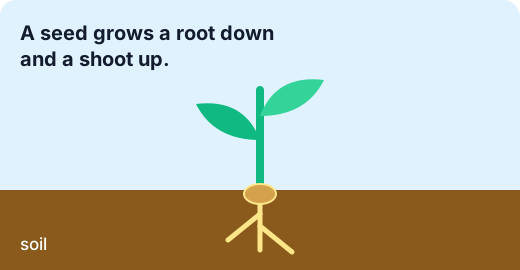
How a seed grows
- The seed drinks water and gets bigger.
- A root grows down into the soil.
- A shoot grows up towards the light.
- The shoot opens its first leaves.
The seed holds a little food inside it. That food feeds the new plant until its leaves are big enough to make food for themselves.
The parts of a plant
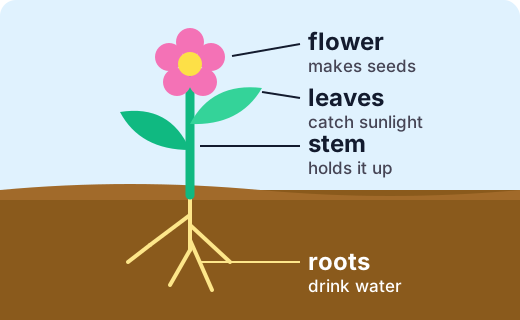
Part What it does Roots hold the plant in the soil and drink water Stem holds the plant up and carries water to the leaves Leaves catch sunlight and use it, with water and air, to make food for the plant Flower makes seeds, so that new plants can grow Some plants we eat have a part you know well. A carrot is a root. Palak (spinach) is a leaf. Sugarcane is a stem. Cauliflower is a bunch of flowers.
What plants need
Plants need three things to grow well:
- Water, which the roots drink.
- Light, usually sunlight, which the leaves catch.
- Air, which the leaves use to make food.
A plant does not eat soil. It makes its own food in its leaves. The soil holds the roots and has water in it.
Example. Tara tried two jars. Jar A stood on the sunny windowsill and she watered it. Jar B stood in a dark cupboard and she watered it too.
After a week, Jar A had strong green leaves. Jar B had a thin, pale, floppy plant. Both had water, but Jar B had no light. So light is one thing a plant needs.
Try it: Grow your own seed! The "Growth diary" activity shows you how. Look at it every day and draw what has changed.
Keeping a growth diary
Scientists write down what they see, so they can compare. Once a week, draw your plant. Write how tall it is (use a strip of paper or count finger-widths) and how many leaves it has. After three weeks, put your drawings next to each other. You will see it grow!
For the grown-up helping
Plants grow slowly, and that is the whole lesson: patience and looking again. Ask "What is different today?" rather than "How big is it?" If a seed does not sprout, that is data too. Plant a few seeds so there is always something to watch. Children often think plants "eat" soil or drink only through their leaves. Roots drinking water is worth showing: stand a white flower or celery stalk in coloured water and watch the colour rise.
Lab
The plant test
Set up four pots, give each a different mix of water and light, and wait three weeks. Which pot grows best?
Your goals
- Set the four pots so each one gets a different mix of water and light.
- Wait three weeks and compare the plants.
- Pick the pot where the plant grew best and say what it had.
The interactive lab opens once you register. Register to do this.
Activity
Growth diary
Your child grows a seed and keeps a diary for three weeks, drawing it once a week. Five minutes to start, then a few minutes each week.
You'll need
- A few moong (green gram) seeds, or other small bean seeds
- A clear jar or cup, cotton wool or kitchen paper
- A small pot with soil (for week 2)
- Paper, pencil and crayons for the diary
- A strip of paper to measure height
Steps
- Soak the seeds in water overnight. They will swell up.
- Put damp cotton wool in the jar and rest two or three seeds on it where you can see them. Put the jar on a bright windowsill. Keep the cotton wool damp, not dripping.
- Week 1 diary. Draw the seeds. Is there a root? A shoot? Write the date.
- When a shoot is a finger long, move the best seedling into a pot of soil, with the roots down. Water it gently and keep it in the light.
- Week 2 and week 3 diary. Draw the plant, measure it with the strip of paper (paste the strip into the diary) and count the leaves.
- After three weeks, put the three drawings side by side. Your child names the roots, stem and leaves on the last drawing.
Safety
- Do not eat raw beans or seeds from the garden. Some are poisonous when raw. Moong sprouts for eating are a different thing, so cook them or follow a recipe.
- Seeds are a choking risk for babies and toddlers. Keep them away from little ones.
- If fuzzy mould grows in the jar, an adult should throw it away without sniffing and wash the jar. Wash hands after handling soil.
Keeping a log of the activity is for registered learners. Register to do this.
Quick check
How plants grow check
Six questions about plants.
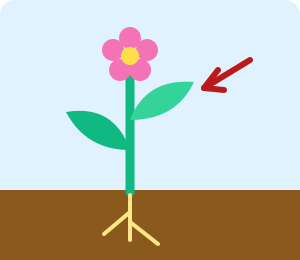
1.Look at the arrow. Which part of the plant is it pointing at?
- Roots
- A leaf
- The flower
Choose one
2.Match each plant part to its job.
- roots
- stem
- leaves
- flower
Match each to: holds the plant up and carries water to the leaves · catch sunlight to make food · makes seeds · hold the plant in the soil and drink water
3.What do plants need to grow well? Pick all that are true.
- Water
- Light
- Air
- Music
Choose all that apply
4.A plant is kept in a dark cupboard and watered every day. What will happen?
- It will grow thin, pale and floppy
- It will grow strong and green
- It will turn into a tree
Choose one
5.Put these in the order they happen when a seed grows.
- The first leaves open
- The seed drinks water
- A root grows down
- A shoot grows up
Put these in order
6.Mia's bean plant was 4 cm tall in week 1 and 9 cm tall in week 2. How many centimetres did it grow?
Answer with a number
Answering and checking are for registered learners. Register to do this.
Quick check
New puzzles
Use what you know about plants in new places.
1.Sam has two plants on the same sunny windowsill. He waters Plant A every day. He never waters Plant B. After two weeks, which plant looks healthier?
- Plant A, because it has water
- Plant B, because it has not been watered
- They look the same
Choose one
2.You want to grow tomato plants on a balcony. Which place is best?
- A sunny spot, watered when the soil feels dry
- A dark corner, watered every day
- Inside a cupboard, never watered
Choose one
3.These are things we eat. Which part of the plant is each?
- carrot
- palak (spinach)
- sugarcane
Match each to: stem · root · leaf
4.Maya puts a flat stone on a patch of grass. A week later the grass under the stone is pale and yellow. Which thing did the grass miss most?
- Light
- Music
- Other grass
Choose one
Answering and checking are for registered learners. Register to do this.
Activity
Tell it back
Your child explains what a plant needs and what its parts do, using a real plant. Five minutes.
You'll need
- A real plant (a pot plant, a weed or a seedling from the diary)
Steps
- Ask your child to show you the roots, stem, leaves and flower (if there is one) on the plant, or on their drawing.
- Ask "What does this part do?" for each part they name.
- Ask "If I never watered this plant, what would happen? What if I put it in a dark cupboard?" Write what they say in their own words.
Keeping a log of the activity is for registered learners. Register to do this.
Like what you see?
Register for free to answer the quick checks, do the activities and save your work. Your work is saved on your device and syncs to your account.