Unit 6
Light and sound
Find out why you can't see in the dark, which materials let light through, and what is shaking when something makes a sound.
Read
Seeing and hearing
The power goes out. The whole house goes dark. Isha cannot see her toys, her shoes, or even her own hand. Then her father switches on a torch, and everything comes back.
Why could Isha see the room only when the torch was on?
Light lets us see
We see things because light reaches our eyes. Light comes from a source, such as the sun, a torch, a lamp or a flame. It bounces off things and into our eyes.
In a room with no light at all, there is nothing to bounce, so you cannot see. A red apple in a dark cupboard cannot be seen at all until the door opens and light gets in.
Light travels in straight lines. That is why a torch makes a straight beam.
What happens when light meets a material
Not every material treats light the same way.
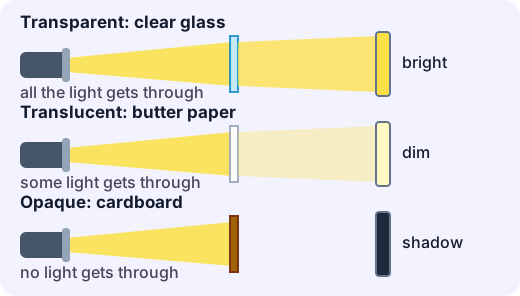
Word Meaning Examples Transparent lets light through, so you can see clearly through it clear glass, a clear plastic bag Translucent lets some light through, but things look blurry butter paper, a thin white cloth, frosted glass Opaque lets no light through wood, metal, cardboard, a brick Where an opaque thing blocks the light, a shadow forms behind it. A shadow is a dark patch where the light cannot reach.
Example. Why is a bathroom window often made of frosted glass? Frosted glass is translucent. It lets daylight in, but nobody outside can see clearly through it.
Example. Why is the door of a cupboard made of wood? Wood is opaque. It hides what is inside.
Try it: In a dim room, shine a torch through a glass, a sheet of paper and your hand. Which let light through?
Sound is shaking
Now think about the drum. When Isha's brother hits a drum, it goes BOOM. What is going on?
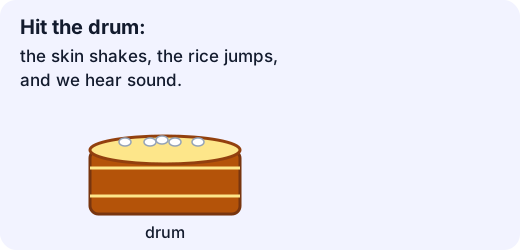
The drum skin vibrates. To vibrate means to shake quickly back and forth. The shaking pushes the air, and the moving air carries the sound to your ears.
You can check this:
- Put some rice grains on a drum and hit it. The grains jump because the skin is shaking.
- Hold your fingers on your throat and hum. You can feel a buzz. That is your voice box vibrating.
- Pluck a rubber band stretched over a box. You can see it blur as it shakes.
Now stop the shaking. Touch the rubber band, or hold a ringing bell tightly. The sound stops. No shaking means no sound.
Loud sounds come from big shakes. Quiet sounds come from small shakes.
Mistakes to avoid
- "If I can't see it, it isn't there." In the dark, things are still there. There is just no light to show them.
- "Sound comes from the thing by itself." Sound comes from the shaking of the thing. Stop the shaking and the sound stops.
- "Transparent and translucent are the same." Through transparent glass you see clearly. Through translucent paper you only see a blur.
For the grown-up helping
Do the experiments together: a torch and a few materials in a dim room, and a drum or a rubber band for sound. Ask "What do you think will happen?" before every try. Children often think seeing happens because their eyes "go out" to the object; the torch-in-the-dark idea (light has to reach the eye) is worth repeating in play. Never shine a torch or any bright light into someone's eyes, and keep sounds at a comfortable volume.
Lab
Does the light get through?
Hold six materials in front of a torch, one at a time. Look at the wall behind. Then sort each material into transparent, translucent or opaque.
Your goals
- Test all six materials in front of the torch.
- Sort each one as transparent, translucent or opaque.
The interactive lab opens once you register. Register to do this.
Activity
Make it shake, make it shadow
Your child finds out that sound is shaking, then shows that light is needed to see. About 25 minutes.
You'll need
- A drum, or a steel plate or pot with a spoon
- A few grains of rice or dry lentils
- A rubber band and an open box or plastic tub
- A torch (or a phone torch) and a dark room or a cupboard
- A cup of clear glass or plastic, a sheet of paper, a piece of cardboard
Steps
- Sound. Put a few grains of rice on the drum or pot lid. Tap it gently with a spoon. Ask "What do the grains do? Why?"
- Stretch a rubber band over the open box and pluck it. Look closely. Can your child see it shake? Can they hear it?
- Touch the rubber band lightly with a finger while it is sounding. What happens to the sound? What does that tell us?
- Light. Go into a dim room. Ask "Can we see the shoes on the floor?" Then switch on the torch and point it at something.
- Shine the torch (never at faces) through the clear cup, the paper and the cardboard onto a wall. Which let light through? Where is the shadow?
- Make a hand shadow on the wall. Move your hand closer to the torch. What happens to the shadow?
Safety
- Never shine a torch or any bright light into anyone's eyes. Never look at the sun.
- Keep the noise at a comfortable level, away from ears. Do not hit anything hard enough to hurt.
- Use a plastic cup if you worry about glass breaking.
- Keep rubber bands and rice away from babies and toddlers (choking).
Keeping a log of the activity is for registered learners. Register to do this.
Quick check
Light and sound check
Six questions about light and sound.
1.A card is held in front of a torch. What is the dark patch on the wall?
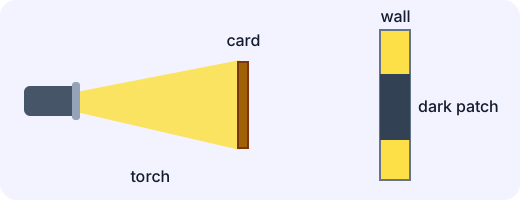
- A shadow, because the card blocks the light
- A hole in the wall
- A dark mark that the card leaves on the wall, like paint
Choose one
2.Which lets all the light through, so you can see clearly through it?
- Clear glass
- Butter paper
- A wooden board
Choose one
3.Match each material to the right word.
- Clear glass
- Butter paper
- Wooden board
Match each to: Translucent · Transparent · Opaque
4.A red apple is in a cupboard with the door shut and no light at all. Can you see it?
- No. We need light to see.
- Yes, because it is red.
- Yes, if I open my eyes wide.
Choose one
5.Why does a drum make a sound when it is hit?
- Its skin shakes (vibrates)
- The stick has sound inside it
- The skin stays perfectly still
Choose one
6.A bell is ringing. You hold it tightly in your hand. What happens to the sound?
- It stops, because you stop the shaking
- It gets louder
- It stays the same
Choose one
Answering and checking are for registered learners. Register to do this.
Quick check
New puzzles
Use what you know about light and sound in new places.
1.Sam puts his hand on his throat and hums. He feels a buzzing. What does this show?
- Sound comes from something shaking
- His throat is hot
- Sound is a kind of light
Choose one
2.A bathroom window should let daylight in but not let people see inside. Which glass is best?
- Frosted glass (translucent)
- Clear glass (transparent)
- A metal sheet (opaque)
Choose one
3.Tara wants to make a shadow puppet on the wall. Which should she cut the puppet from?
- Cardboard
- A clear plastic bag
- Clear glass
Choose one
4.Ria plucks a rubber band and it hums. She touches it with her finger and the hum stops. Why?
- Her finger stopped the rubber band shaking
- Her finger blocked the light
- The rubber band got tired
Choose one
5.Leela puts something between a torch and a wall. She still sees a bright patch of light on the wall. What did she most likely put there?
- A clear glass cup
- A wooden board
- Her hand
Choose one
Answering and checking are for registered learners. Register to do this.
Activity
Tell it back
Your child explains where sound comes from and why we need light to see. Three minutes.
Steps
- Ask "What makes a drum go BOOM? How do you know?" Let your child use the drum or a rubber band if they want.
- Ask "Why can't we see in a dark cupboard? What do we need?"
- Ask "Which would you use for a window, glass or cardboard? Why?" Write down what your child says.
Keeping a log of the activity is for registered learners. Register to do this.
Like what you see?
Register for free to answer the quick checks, do the activities and save your work. Your work is saved on your device and syncs to your account.