Unit 3
Nutrition for growth
Why growth spurts need extra iron and calcium, and how to plan a week of teenage meals that supply them.
Read
Fuel for a growth spurt
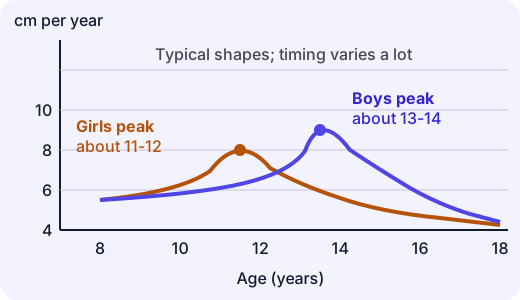
Farida's grandmother kept a pencil mark on the kitchen doorframe every birthday. Between age 7 and 10, Farida moved up the doorframe by about 5 cm a year. Between 11 and 12, the pencil marks suddenly jumped 8 cm in a single year. Her shoes no longer fit, she was hungry all the time, and she felt tired by evening. Nothing was wrong. Farida was in a growth spurt.
What a growth spurt is
In puberty, height growth speeds up for a few years. For girls the fastest year is usually around age 11 to 12, for boys around 13 to 14, though it can be earlier or later and still be healthy. At the peak, a teenager grows about 7 to 10 cm in a year, compared with about 5 to 6 cm a year in the quieter years before.
It is not only height. During the spurt the body also:
- builds bone: by the end of the teens about 90% of adult bone mass is in place, so the bone you build now is the bone you will have for life;
- makes more blood, because a larger body needs more blood to carry oxygen;
- builds more muscle, especially in boys;
- uses a lot of energy just to run all this construction.
A construction site needs bricks, cement and steel. Your growing body needs energy, protein, many vitamins and minerals. Two minerals matter especially in this period: calcium and iron.
Calcium: the building material for bones
About 99% of the calcium in the body is in the bones and teeth. A teenager needs about 1,000 to 1,300 mg a day, depending on the country's guideline. If the diet falls short during these years, the body cannot build the bone it will need later, and the shortfall is hard to make up.
Good sources:
- Milk, curd, paneer, cheese: the easiest sources for those who eat dairy. A glass of milk has about 300 mg.
- Ragi (finger millet): a ragi roti has about 140 mg, among the best plant sources in India.
- Sesame (til), almonds, small fish eaten with bones, tofu set with calcium, and fortified plant milks where available.
- Green leafy vegetables such as spinach contain calcium, but it is poorly absorbed, so they are helpful but should not be your main source.
Calcium also needs vitamin D to be absorbed. Your skin makes vitamin D when sunlight falls on bare arms and legs, so playing outdoors in daytime sunshine helps bones as well as muscles.
Iron: the oxygen carrier
Iron is the key part of haemoglobin, the red substance in blood that carries oxygen from the lungs to every part of the body. Growth needs more blood, so it needs more iron. Girls who have periods also lose some iron each month. If a person does not get enough iron, they can become anaemic: tired, pale, dizzy, short of breath on exercise, and unable to concentrate. In the national health survey NFHS-5 more than half of Indian girls aged 15 to 19 were found to be anaemic, which is why iron is a national concern. Many Indian schools give a weekly iron and folic acid tablet; if yours does, take it as the health worker says.
Good sources:
- Legumes and pulses: chana, rajma, dal, lentils.
- Green leafy vegetables: spinach (palak), amaranth, fenugreek (methi).
- Whole grains and millets: ragi, bajra, whole wheat.
- Jaggery, dates, dried figs, sesame.
- Eggs, meat, fish and liver for those who eat them. Iron from animal foods ("haem" iron) is absorbed better than iron from plants.
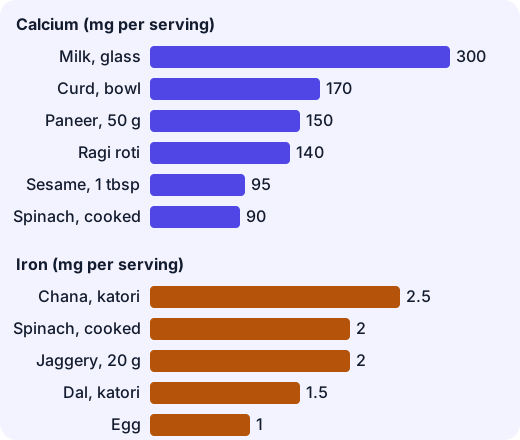
Numbers are rounded estimates from food tables. Real foods vary with how they are grown and cooked.
Helping your body absorb iron. Plant iron is absorbed poorly unless you help it.
- Add vitamin C at the same meal: lemon on dal, a guava or orange after lunch, amla chutney with a roti, tomato in a vegetable curry. Vitamin C can make plant iron absorb two to three times better.
- Keep tea and coffee away from meals. They contain tannins that block iron. Drink them an hour before or after eating.
- Soak, sprout or ferment grains and pulses (idli, dosa, sprouted moong). This reduces natural compounds that block iron.
Misconception. "Spinach is the best iron food." Spinach has iron, but it also has compounds that make that iron hard to absorb. It is a useful food among many, not a magic one. Pulses, jaggery, ragi, eggs and meat all matter too.
Misconception. "A teenager should diet to stay slim during growth." Growth needs energy. Skipping meals or crash diets can slow growth and cause anaemia. If you are worried about your weight, speak to a doctor, not a social media influencer.
Planning a teenager's week
You can plan a good week in four steps.
- Start with the plate. At each main meal, half the plate is vegetables and fruit, a quarter whole grains, a quarter protein (dal, pulses, egg, fish, paneer, tofu). Add curd or milk.
- Count the key minerals. Make sure each day has about 3 calcium sources (for example milk, curd, ragi) and 3 iron sources (for example dal, chana, a green leafy vegetable, jaggery).
- Add vitamin C and avoid tea at meals.
- Vary the days. Variety covers other vitamins and minerals, and keeps meals interesting.
Worked example: calcium. Target about 1,000 mg. Anil, a vegetarian, plans: 2 glasses of milk (2 × 300 = 600 mg), 1 bowl of curd (170 mg), 1 ragi roti (140 mg), 1 tablespoon of sesame in a chutney (95 mg).
Just reaches the target. Notice that milk alone is not enough: several smaller sources add up.
Worked example: iron. Target about 15 mg (the guideline varies by country and sex; Indian guidelines are higher than some others because plant iron is absorbed less well). Anil's pulses and greens: 1 katori chana (2.5), 1 katori palak (2), 1 katori dal (1.5), 2 whole-wheat rotis (2 × 1.2 = 2.4), 1 ragi roti (1.5) and 1 piece of jaggery (2):
He is about 3 mg short. He can add a second ragi roti (1.5) and a second serving of palak (2) and finish with an orange for vitamin C. Planning means checking the total, not hoping.
A safety note. Iron and other supplements should be taken only when a doctor or health worker prescribes them. Too much iron is dangerous, especially for children. Food comes first. People who are allergic to milk, or who eat no animal food, can plan a healthy diet but should ask a doctor or dietitian about vitamin B12 and other nutrients.
Try it: Write down everything you ate yesterday. Circle the calcium sources and underline the iron sources. Which meal had none? How could you change it using food your family already eats?
Lab
Plan three growth days
Plan the food for a 12-year-old's growth. Choose servings of everyday Indian foods and watch the calcium and iron meters. Each day needs about 1000 mg of calcium and 15 mg of iron without going over 12 servings.
Your goals
- Meet the calcium and iron targets on Day 1, Day 2 and Day 3.
- Stay within 12 servings a day and 3 of any one food.
- Make the three days different from each other.
The interactive lab opens once you register. Register to do this.
Quick check
Nutrition for growth check
Eight questions on why growth spurts need more calcium and iron and how to meet the need.
1.Why do teenagers need plenty of calcium during a growth spurt?
- Calcium gives the body energy, like sugar
- Bones are being built quickly, and most adult bone mass is laid down by the end of the teens
- Teenagers lose all their calcium every night
- Calcium makes muscles grow longer
Choose one
2.What does iron do in the body?
- It gives energy directly
- It is part of haemoglobin, which carries oxygen in the blood
- It makes bones hard
- It fights all infections
Choose one
3.Which of these are good sources of iron? Choose all that apply.
- Packaged chips
- A sweet fizzy drink
- Jaggery
- Dal
- Chana (chickpeas) or rajma
Choose all that apply
4.Sana has 1 glass of milk (300 mg calcium), 1 bowl of curd (170 mg) and 2 ragi rotis (140 mg each). How many milligrams of calcium is that?
Answer with a number
5.Which meal helps the body absorb the most iron from the dal?
- Dal and rice with lemon squeezed on, followed by a guava
- Dal and rice with a cup of strong tea
- Dal and rice with a cup of coffee
- Dal alone, eaten very quickly
Choose one
6.Match each nutrient to its job.
- Calcium
- Iron
- Vitamin C
- Vitamin D
Match each to: Carries oxygen in the blood · Helps absorb calcium; made in the skin from sunlight · Helps absorb iron from plant foods · Builds bones and teeth
7.A 13-year-old in a growth spurt wants to skip dinner every day to stay slim. What is the best advice?
- Skip dinner but double the tea
- Good idea; teenagers should eat as little as possible
- Skip dinner, but eat only chips at lunch
- Do not skip meals; growth needs energy and nutrients. If worried about weight, talk to a doctor
Choose one
8.A lunch has 1 katori chana (2.5 mg iron), 2 katoris dal (1.5 mg each) and 1 piece of jaggery (2 mg). How many milligrams of iron is that in total?
Answer with a number
Answering and checking are for registered learners. Register to do this.
Quick check
New nutrition puzzles
Use what you know about calcium, iron and growth in situations the reading did not show.
1.Priya eats no dairy or other animal foods. Which choices help her meet her calcium needs? Choose all that apply.
- Plant milk that is fortified with calcium
- Polished white rice only
- Ragi rotis
- A sweet fizzy drink
- Sesame (til) chutney or laddu
Choose all that apply
2.Ben has strong tea with every meal and rarely eats fruit. His iron is low. Which single change helps most?
- Drink tea an hour before or after meals, and add a vitamin C fruit like guava or orange to meals
- Take any iron tablets he finds at home
- Drink more tea so the iron in it is used
- Stop eating dal
Choose one
3.Zoya needs 15 mg of iron a day. Her usual day gives about 9.5 mg. How many milligrams of iron is she short over one week (7 days)?
Answer with a number
4.A teenager is tired and pale for several weeks, gets dizzy climbing stairs and cannot concentrate. What is the best next step?
- Buy iron tablets and take as many as possible
- Tell a parent or teacher and see a doctor or health worker for a check (for example for anaemia)
- Stop eating all green vegetables
- Wait until it goes away without telling anyone
Choose one
5.Rahul is 13 and has not grown much, while his friend Dev grew fast at 12. Rahul is worried. What is the most accurate thing to tell him?
- He should stop playing sport
- He will never grow because he started late
- He should take iron tablets without asking anyone
- Growth spurts start at different times; many boys have theirs at 13 to 14. Eat well, and see a doctor if he is still worried
Choose one
Answering and checking are for registered learners. Register to do this.
Your turn
Plan a teenager's week of food
Use the food values from the reading (milk 300 mg calcium per glass, curd 170 per bowl, ragi roti 140 calcium and 1.5 iron, chana 2.5 iron per katori, spinach 2 iron per katori, jaggery 2 iron, dal 1.5 iron, egg 1 iron, sesame 95 calcium and 1.5 iron). Targets: 1000 mg calcium and 15 mg iron a day.
Part 1. Plan one full day of food for a 12-year-old vegetarian (breakfast, lunch, snack, dinner). Show the calcium and iron totals with your adding, and say whether each target is met.
Part 2. Write a two-day variation of your plan for a teenager who eats no dairy. Name the main calcium sources you use instead.
Part 3. Explain in 4 or 5 sentences why growth spurts need more iron and calcium, and give two tips for helping the body absorb iron.
How it's judged
- Plan and arithmetic
- Dairy-free variation
- Explanation
Writing and submitting your answer is for registered learners. Register to do this.
Like what you see?
Register for free to answer the quick checks, do the activities and save your work. Your work is saved on your device and syncs to your account.