Unit 3
Collage and 3D art
Glue found materials flat into a collage, then build a small sculpture that takes up space and can be seen from all sides.
Read
Flat art and art that stands up
After a festival, Zainab's family has a pile of things that nobody wants: torn wrapping paper, a cardboard tube, bits of ribbon, dry leaves and a few bottle tops.
"Rubbish," says her brother.
"Art," says Zainab. "Wait and see."
She has just learned that artists can make something wonderful from things other people throw away.
Found materials
Found materials are things you find, save or collect, rather than buy as art supplies: paper scraps, cloth, leaves, cardboard, buttons, bottle tops, clean boxes, string. Using them also helps the planet, because the things get a new life instead of becoming waste.
Always choose things that are clean, dry and safe. Never use glass, sharp metal, or anything that has held food, such as egg boxes or yoghurt pots, unless an adult has washed it well.
Collage: art that is flat
A collage (say kuh-LAHZH) is a picture made by gluing pieces of different materials onto a flat base such as card. The word comes from a French word meaning "to glue".
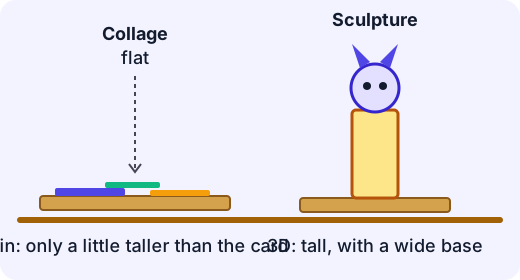
You can tear paper for soft edges or cut it for sharp ones. You can overlap pieces to make new shapes and colours. Zainab makes a collage of a peacock: a blue paper body, green leaf feathers with ribbon tips, and bottle-top eyes.
Tips for a good collage
- Arrange the pieces on the card before you glue anything.
- Start with the biggest background pieces, then add smaller ones on top.
- Use a thin layer of glue and press each piece flat.
- Mix textures, such as shiny and rough, to make it interesting.
Sculpture: art that takes up space
A sculpture is art you can walk around. It has a front, a back and sides. It is 3D, which means it has height, width and depth, so it takes up space.
Zainab's next piece is a sculpture. She stands the cardboard tube upright for the body, fixes a ball of scrunched paper on top for the head, and pushes two thin card ears into slits.
Look back at the picture. The collage is flat: it hangs on a wall and you look at it from the front. The sculpture stands on a table and you can look at it from all sides.
How to make a sculpture stand
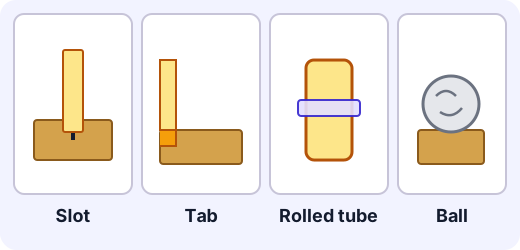
- Give it a wide, flat base. Tall things with tiny bases fall over.
- Join parts firmly with glue, tape, slots or folded tabs.
- Put heavy parts low, light parts high.
- Test it gently. If it wobbles, fix the base first.
Example. Zainab's first giraffe tipped forward. Its neck was long and its legs were thin. She glued the feet onto a wide piece of card, and it stood.
A mistake to watch for
Many people think a sculpture must be made of stone or metal. Not so. A sculpture can be made of paper, clay, wood, cardboard or any found material. What makes it a sculpture is that it is 3D.
For the grown-up helping
Collect clean household throw-aways together, and let your child choose what to use. Cut thick cardboard for them, as it needs a strong blade. When the sculpture wobbles, ask "What could we change at the bottom?" instead of fixing it for them. It is fine if it looks different from what they planned; ask them to tell you what it is.
Activity
Make a found-material collage
Your child makes a flat picture by gluing different found materials onto card. About 35 minutes.
You'll need
- A sheet of card or a flattened cardboard box for the base
- Clean, dry found materials such as paper scraps, old magazines, cloth, ribbon, leaves, seeds and flat buttons
- A glue stick or school glue, and a spreader such as a spare piece of card
- Blunt children's scissors (tearing by hand works too)
- A tray or box lid to hold the pieces
Steps
- Collect found materials and sort them into the tray by kind, such as paper, cloth and nature.
- Decide what the picture will be, such as a bird, a house, a boat or a garden.
- Without any glue, move the pieces about on the card until you like the picture. Take your time.
- Glue the biggest pieces first, and press them flat. Use a thin layer of glue.
- Add smaller pieces on top. Overlap some of them.
- Add at least three different textures, such as smooth paper, rough cloth and a dry leaf.
- Let it dry flat for at least an hour. Ask, "What materials did you use, and what is each one?"
Safety
- Use only clean, dry things. No glass, sharp metal, food waste or anything that has been in a bin.
- Small things such as buttons and seeds are a choking risk for young children. Keep them away from babies and toddlers and supervise closely.
- Use blunt scissors only. Do not put glue near eyes or mouth.
- Wash hands afterwards, especially after touching leaves or outdoor things.
Keeping a log of the activity is for registered learners. Register to do this.
Activity
Build a small sculpture
Your child builds a small animal or creature from found materials that stands up by itself and can be seen from every side. About 40 minutes.
You'll need
- Found materials such as cardboard tubes, small boxes, clean paper cups, scrunched paper, bottle caps (clean) and string
- A flat piece of card for the base
- Strong glue or masking tape (an adult helps with the glue gun if you use one)
- Paint or coloured paper to decorate (optional)
- Blunt scissors
Steps
- Look at your pile of materials. Choose a creature to build, such as a robot, a bird, a giraffe or a monster.
- Make the base first. Glue or tape the creature's feet or bottom onto the flat card so that it is wide and steady.
- Build the body on the base. Use a tube, a box or scrunched paper.
- Join the other parts. Try a slot (a cut for card to slide into), a folded tab with glue, or tape.
- Put heavy parts low and light parts high. Gently test whether it stands up. If it wobbles, make the base wider.
- Decorate it. Make sure there is something interesting at the back and the sides, not only at the front.
- Walk around it with your child. Ask, "What can you see from the back? What changes when you look from above?"
Safety
- An adult cuts thick cardboard and does any hot glue gun work. Children use blunt scissors only.
- Use only clean, dry materials with no sharp or broken edges. Do not use cans, glass or anything that has held chemicals.
- Keep small parts away from babies and toddlers.
- Tidy the floor afterwards so nobody trips on scraps.
Keeping a log of the activity is for registered learners. Register to do this.
Quick check
Collage and 3D check
Six questions about collage, sculpture and found materials.
1.Look at the two side views. Which one is a sculpture?
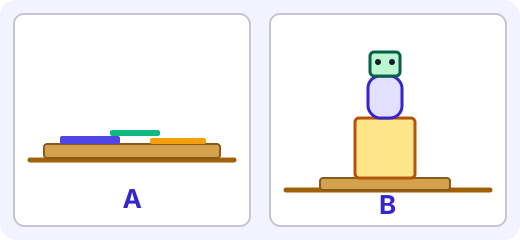
- A
- B
Choose one
2.What is a collage?
- A picture made by gluing pieces of different materials onto a flat base
- A figure shaped from clay that stands up
- A picture made only with paint
Choose one
3.Which of these are safe found materials for a collage?
- A clean cardboard tube
- A dry leaf
- A scrap of old cloth
- A piece of broken glass
Choose all that apply
4.Dev's tall cardboard tower keeps falling over. It stands on a very small base. What is the best fix?
- Glue it to a wider, flatter base
- Make it even taller
- Put the heaviest thing on the very top
Choose one
5.Put the steps of building a sculpture in the best order.
- Make a wide, steady base
- Test gently that it stands up
- Join the body and other parts onto the base
- Choose what to make from your pile of materials
Put these in order
6.Match each word to its meaning.
- Collage
- Sculpture
- Found materials
Match each to: Art you can walk around · Things you collect and reuse · Pieces glued flat onto a base
Answering and checking are for registered learners. Register to do this.
Quick check
New puzzles
Collage and sculpture turn up in new places. Can you use what you know?
1.Kabir tears pieces of old newspaper and glues them flat on card to make a city skyline. What kind of art is it?
- A collage
- A sculpture
- A print
Choose one
2.Sana's cardboard giraffe tips forward because its legs are thin and its neck is long. What should she do?
- Glue the feet onto a wide piece of card
- Make the neck even longer
- Nothing; sculptures always fall over
Choose one
3.Mira wants her artwork to look interesting from the front, the back and both sides. What should she make?
- A sculpture
- A flat collage on a card
- A drawing on one sheet of paper
Choose one
4.Leo's collage has 3 leaves, 4 scraps of cloth and 5 pieces of paper glued on it. How many pieces are glued on in all?
Answer with a number
Answering and checking are for registered learners. Register to do this.
Activity
Tell it back
Your child explains, in their own words, how a collage and a sculpture are different. Two minutes.
Steps
- Put the collage and the sculpture side by side in front of your child.
- Ask: How is this one different from that one? Which one can you walk around?
- Ask: What found materials did you use, and what did you do with them?
- Write down what your child says in their own words. Do not correct them.
Keeping a log of the activity is for registered learners. Register to do this.
Like what you see?
Register for free to answer the quick checks, do the activities and save your work. Your work is saved on your device and syncs to your account.