Unit 6
Dance
Learn a short folk dance in a circle, then make up your own moves that tell a story to music.
Read
Moves that tell a story
When the harvest is in, people in Punjab dance the bhangra: big jumps, raised arms, shoulders shaking to the beat of the dhol. They are not just having fun. Their dance is also saying, "We worked hard. The crop is good. We are glad."
That is what dance does. Dance tells stories with movement, even with no words.
Folk dances
A folk dance is a dance that a community has danced for a long time, handing it from parents to children. Many are danced at festivals, weddings and harvests, usually in groups.
- Garba from Gujarat is danced in a circle, often around a lamp, in the nine nights of Navratri. Dancers step and clap in time.
- Bihu from Assam is danced at spring festivals, with quick hand moves and swaying hips.
- Bhangra from Punjab is a high-energy harvest dance.
- Around the world, people dance in circles and lines too: the ceilidh dances of Scotland and Ireland, the sirtaki of Greece, and the haka of the Māori people of New Zealand, which shows strength and pride.
Folk dances are often built from a few simple moves that repeat. Anyone can join in.
Moves to music
Dancers listen first. The beat of the music tells your feet when to step. Then they decide what the moves say.
You can change any move in three ways, and each change gives it a new feeling:
Change Example Speed A slow sway is calm. A fast sway is excited. Size Small, tight moves feel shy or cold. Big, wide moves feel bold or happy. Level Low to the floor feels heavy or sleepy. Up on your toes feels light, like growing. Try it: Walk across the room as if you were very tired. Now walk as if you had just won a prize. Your feet are the same! What changed? Speed, size and level.
Learning a short dance
A dance is a list of moves in an order. Learn it a small piece at a time. Count the beats aloud: "1, 2, 3, 4, 5, 6, 7, 8". Here is a simple circle dance in 8 beats:
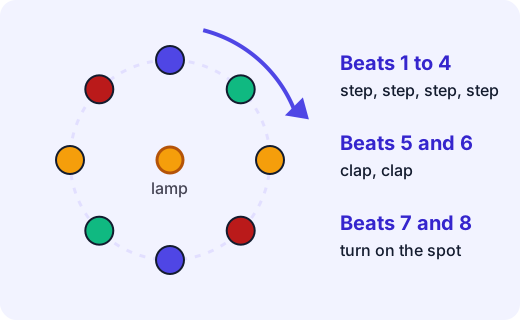
Example. Beats 1 to 4: step to your left four times, so the circle moves clockwise around the lamp. Beats 5 and 6: clap twice. Beats 7 and 8: turn once on the spot. That is beats. Do it three times and you have danced beats.
Making up your own
Choose a story and give each part a move. Here is a harvest story in four parts.
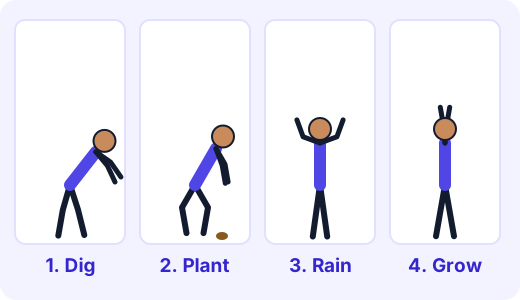
- Dig: bend forward and dig the ground.
- Plant: crouch and place a seed.
- Rain: wiggle your fingers as you lift them up and then lower them.
- Grow: slowly rise, from small to tall, arms wide.
Give each part four beats. Now you have a sixteen-beat dance that tells the story of a seed. Put it to music and the story comes alive.
A mistake to watch for
Some children think dancing means copying exactly, or that there is only one right way. When you learn a folk dance, the steps are fixed, so that the group can dance together. But when you make up a dance, there is no wrong move, as long as the move says something and keeps to the beat.
For the grown-up helping
Clear a safe space and join in. Children learn dance by watching, so dance badly with confidence! Count the beats aloud and keep the pieces short. If your child is shy, begin with a story they love and ask, "How would a tiger walk? How would a butterfly?" Wobbles and missed steps are completely normal; the aim is moving to the beat and enjoying it.
Activity
Learn a circle dance
Your child learns a short circle dance in eight beats, with family or friends, and dances it to music. About 25 minutes with at least three dancers.
You'll need
- A clear floor space big enough for a circle
- A cushion to put in the middle of the circle, standing in for the lamp
- A song with a steady beat (a folk song, a garba or bhangra track, or any music everyone likes)
- A device to play the music
Steps
- Stand in a circle around the cushion. First, just clap the beat of the music together and count "1, 2, 3, 4, 5, 6, 7, 8" over and over.
- Learn part one without music. Beats 1 to 4: step to your left, one step on each beat, so the circle moves clockwise around the cushion. Do it slowly until everyone is steady.
- Learn part two. Beats 5 and 6: clap twice. Beats 7 and 8: turn once on the spot. Say the words aloud as you do them: step, step, step, step, clap, clap, turn, turn.
- Put the whole eight beats together. Repeat it until it flows.
- Add the music. Listen for the beat first, then start on the count of 1. Dance the eight beats again and again until the song ends.
- Change it once. Try the same dance very slowly, then very fast. Ask: What changes in the feeling?
- Teach someone else. Your child can lead and teach the dance, one part at a time.
Safety
- Clear the floor of toys, cables and anything sharp. Use a cushion, not a lit lamp, in the middle of the circle.
- Dance on a floor that is not slippery. Wear socks with grip, shoes or bare feet, not loose socks on a smooth floor.
- Keep a gap between dancers so nobody bumps into anyone when they turn.
- Have water ready, and rest when you are tired or dizzy. Stop turning if you feel dizzy.
Keeping a log of the activity is for registered learners. Register to do this.
Activity
Dance your own story
Your child chooses a story, makes up a move for each part, and dances it to a piece of music. About 30 minutes.
You'll need
- A clear floor space
- A piece of music with a steady beat, 1 to 2 minutes long
- A device to play the music
- Paper and a pencil to write or draw the order of the moves
Steps
- Choose a story with four parts. Some ideas are a seed growing, a bird flying home, a storm that turns calm, or a day at the market. You can use the harvest story from the reading.
- Listen to the music together and clap the beat. Count in "1, 2, 3, 4".
- Find one move for each part of the story. Ask: How would this part move? Fast or slow? Big or small? Low or high? Try each move three ways and keep the best.
- Give each part four or eight beats. Write or draw the four moves in order on the paper.
- Practise without music, counting aloud. Then dance it to the music. If the music ends before the dance, repeat the dance or start again.
- Dance it for the family, and ask them to guess the story from the moves alone.
- Talk about it. Ask: Which move was easiest to read? Which would you change?
Safety
- Clear the floor of toys, cables and anything sharp, and keep dancers away from furniture corners.
- Dance on a floor that is not slippery, in shoes with grip or bare feet.
- Keep the music at a friendly volume.
- Have water ready, and rest when tired. Stop spinning if you feel dizzy.
Keeping a log of the activity is for registered learners. Register to do this.
Quick check
Dance check
Seven questions about folk dance and making up moves.
1.What is a folk dance?
- A dance a community has danced for a long time and passes on, often at festivals
- A dance invented by one person yesterday
- Any dance that is fast
Choose one
2.How can a dance tell a story?
- The moves show what is happening and how it feels
- Only by dancers saying the words aloud
- It cannot; dance has no story
Choose one
3.A dancer tells the story of a seed. Put the four parts in the order they happen.
- Plant the seed
- Dig the ground
- The plant grows tall
- Rain falls
Put these in order
4.Which pose would best show a plant growing taller?
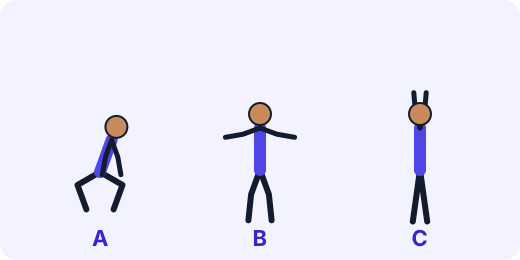
- A, then B, then C
- C, then B, then A
- B only
Choose one
5.A dance has 8 beats. You step on 4 beats and clap on 2 beats. The rest of the beats are for a turn. How many beats do you turn?
Answer with a number
6.You want to make up moves to a piece of music. What should you listen for first, so your feet know when to move?
- The beat
- The singer's name
- The last note
Choose one
7.Which of these can you change to make the same step look and feel different?
- How fast you do it
- How big you make it
- How high or low you do it
- The colour of your socks
Choose all that apply
Answering and checking are for registered learners. Register to do this.
Quick check
New puzzles
Dance moves can be read like words. Can you use what you know?
1.Isha wants to dance a storm that slowly becomes calm. Which plan fits best?
- Fast, sharp, big moves that slowly become slow, soft, small moves
- Slow, soft moves that become fast and sharp
- The same move all the way through
Choose one
2.Kabir wants to show a bird flying. Which moves tell it best?
- Arms wide, light steps, gentle swooping
- Heavy stomping with arms tight at the sides
- Staying low on the floor and still
Choose one
3.Twelve dancers stand in a circle and each holds hands with the dancer on each side. How many pairs of joined hands are there?
Answer with a number
4.Why do the dancers in a folk dance take the same steps at the same time?
- So the group moves together as one, on the same beat
- Because they are not allowed to think of their own moves
- So the audience cannot see them
Choose one
5.A dance takes 8 beats. How many beats do you dance if you do it 5 times?
Answer with a number
Answering and checking are for registered learners. Register to do this.
Activity
Tell it back
Your child explains, in their own words, how their dance tells a story. Three minutes.
Steps
- Ask your child to show you their favourite move from the dance and tell you what it means.
- Ask: How did you make that part of the dance feel sad (or happy, or sleepy, or strong)? What did you change, such as speed, size or level?
- Ask: How does the music help your feet know what to do?
- Write down what your child says in their own words. Do not correct them.
Keeping a log of the activity is for registered learners. Register to do this.
Like what you see?
Register for free to answer the quick checks, do the activities and save your work. Your work is saved on your device and syncs to your account.