Unit 5
Playing instruments together
Play drums, shakers and a xylophone in a group, and discover what keeps everyone together.
Read
Everyone on the same beat
At a wedding procession, the band walks down the street. There are drums, cymbals, a trumpet or two. Dozens of people play at the same time, and yet it sounds like one big piece of music. How do they do that?
The secret is simple. They all feel the same steady beat.
Two families of instruments
Percussion instruments make sound when you hit, shake or scrape them. Drums, the dholak, the tabla, manjira (small cymbals), claves (two wooden sticks), a shaker made from a tin filled with rice: all are percussion. Percussion is great for keeping the rhythm, the pattern of long and short sounds.
A xylophone is made of wooden or metal bars in a row. You hit the bars with a mallet, a stick with a soft head. It is a percussion instrument that can play a melody, because each bar has its own pitch. The long bars sound low and the short bars sound high, just like long and short strings.
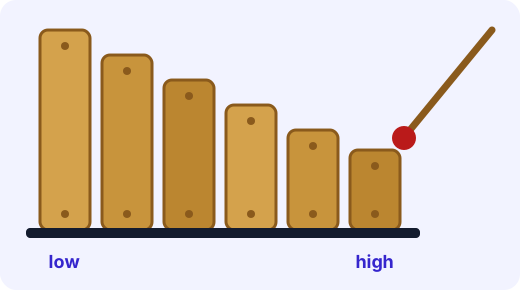
Try it: Hold a ruler flat over the edge of a table, press one end down, and flick the other end. Now let more of the ruler hang over and flick again. The long part wobbles slowly and sounds low. The short part buzzes fast and sounds high.
The steady beat
You met the steady beat in Level 1. It is the tick that never changes, like a heartbeat or a clock. When a group plays together, everyone follows the same beat.
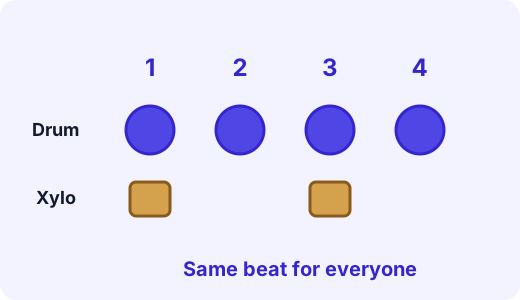
Look at the picture. The drum plays on every beat: 1, 2, 3, 4. The xylophone plays on beats 1 and 3 only. They play different things, but they sit on the same beats, so they fit together like pieces of a puzzle.
Example. The group plays 4 beats, over and over. The drum hits on every beat, so it hits 4 times. The xylophone hits on beats 1 and 3, so it hits 2 times. In 3 rounds, the drum plays times and the xylophone plays times. Between them: 18 sounds, all on the beat.
How to play well in a group
- Count in. One person says "1, 2, 3, 4" aloud, steady and clear. Then everyone starts on the next beat together.
- Listen while you play. Listening matters more than playing loud.
- Hold the beat. Do not rush. If you speed up, you leave the others behind.
- Hit well. Strike the middle of a xylophone bar and lift the mallet at once so the sound can ring. Hit a drum with a relaxed hand.
- Stop together. The leader gives a clear sign, like a raised hand.
A mistake to watch for
Some players think the beat is wherever their hands are. If you get ahead of the group, it is you who must fix it. Stop and listen to the others, find their beat and join it on the next count. Even good musicians do this all the time.
For the grown-up helping
Be the leader the first few times: count in, keep a steady beat and give a clear stop. Home-made instruments are great, such as pots and wooden spoons, rice in a tin, or bottles with different amounts of water. Ask your child, "Can you hear the others?" before "Can you play it right?" Rushing is the most common thing at this age, and it gets better with listening.
Lab
The beat band
Build a small band with a drum part and a xylophone part. Eight beats make one round. Tap squares to add sounds, press Play and listen to how the two parts fit on one steady beat. Try a faster and a slower speed.
Your goals
- Give the drum hits on at least four of the eight beats, including beat 1.
- Give the xylophone at least four notes, using at least two different pitches.
- Press Play and let your band play two full rounds together.
The interactive lab opens once you register. Register to do this.
Activity
Start a family band
Your child plays a rhythm and a simple melody in a small group, keeping the same beat as everyone else. About 30 minutes with two to five players.
You'll need
- Two or three home-made percussion instruments, such as a pot with a wooden spoon, a tin with rice in it, or two pencils to tap
- A xylophone, if you have one, or a row of cups with different amounts of water and a spoon (the cup with the most water makes the lowest sound)
- A cushion or tray to lay the instruments on
- Optional, a song everyone knows, such as a school song or a lullaby
Steps
- Sit in a circle. The adult claps a slow, steady beat and says "1, 2, 3, 4". Everyone claps along. Practise stopping all together when the adult raises a hand.
- Hand out the instruments. The drummers play one hit on every beat while the adult counts "1, 2, 3, 4" out loud.
- The melody player taps a note on beat 1 and beat 3 only, playing a low note on beat 1 and a higher note on beat 3. The drummers keep their beat steady underneath.
- Now the drummers try a different rhythm, such as two quick hits on beat 3, while the melody player keeps hers. Count aloud so nobody gets lost.
- Swap instruments so everyone plays each part.
- Play a song everyone knows. Ask the group to choose one player to count in. Start together, play the whole song and stop on the signal.
- Talk about it. Ask "When did we sound best? What helped us stay together?" If someone rushed, ask the group what they could do to help (listen, slow down, look at the leader).
Safety
- Keep the volume friendly. Do not play very loud or close to anyone's ears.
- Use plastic or steel cups, not thin glass. An adult checks that nothing can fall or tip.
- Do not use anything sharp, heavy or glass as a stick or mallet. A wooden spoon is fine.
- Wipe up spilled water straight away.
Keeping a log of the activity is for registered learners. Register to do this.
Quick check
Playing together check
Seven questions about playing instruments in a group.
1.What helps a whole group play together?
- Everyone follows the same steady beat
- Everyone plays as loudly as they can
- Everyone plays as fast as they can
Choose one
2.Which of these are percussion instruments (you hit, shake or scrape them)?
- A drum
- A rice shaker
- A flute
- A harmonium
Choose all that apply
3.Which bar makes the lowest sound?
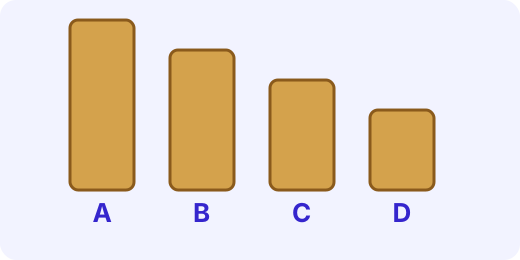
- A
- B
- C
- D
Choose one
4.Put these in the best order for starting to play a piece as a group.
- The leader counts 1, 2, 3, 4
- Everyone keeps listening while playing
- Everyone starts together on the beat
- The leader signals and everyone stops together
Put these in order
5.What do we call the steady tick that everyone in the group follows?
Answer with a word or phrase
6.Aarav notices he has got ahead of the others. What should he do?
- Listen to the others and join their beat again
- Play louder so they follow him
- Walk out and stop playing for good
Choose one
7.A drum plays one hit on every beat. A round has 4 beats. How many drum hits are there in 3 rounds?
Answer with a number
Answering and checking are for registered learners. Register to do this.
Quick check
New puzzles
Group playing shows up in new places. Can you use what you know?
1.Tara plays one hit on each beat. Dev plays two quick hits on each beat. In 4 beats, how many hits does Dev play?
Answer with a number
2.A round has 8 beats. The drum plays on every beat. The xylophone plays on every second beat. How many sounds are there in one round, drum and xylophone together?
Answer with a number
3.Meera loses her place in the middle of a song and cannot hear where the others are. What is the best thing to do?
- Stay quiet for a moment, listen for the beat, then join in on the next count
- Play as loudly as possible until she finds her place
- Stop the whole group and start again from the very beginning
Choose one
4.You want to play a very low note on a wooden xylophone. Which bar do you hit?
- The longest bar
- The shortest bar
- Any bar, they all sound the same
Choose one
5.Four friends bang pots and spoons. Each one hits at a different speed and nobody listens. What will the music sound like?
- A jumble, because there is no shared beat
- A perfect band, because everyone is playing
- Silent
Choose one
Answering and checking are for registered learners. Register to do this.
Activity
Tell it back
Your child explains, in their own words, what keeps a group together when they play, and what each instrument did. Three minutes.
Steps
- Ask your child "Four people played at the same time. Why did it sound like one song and not four?"
- Ask: What do you do when you get ahead of the others?
- Ask: What was the difference between the drum's job and the xylophone's job?
- Write down what your child says in their own words. Do not correct them.
Keeping a log of the activity is for registered learners. Register to do this.
Like what you see?
Register for free to answer the quick checks, do the activities and save your work. Your work is saved on your device and syncs to your account.