Unit 4
Food gives energy
Find out which foods are fuel for running and which are building bricks for growing, then plan a whole day of meals.
Read
Fuel and building bricks
Kabir has a cricket match at four o'clock. At lunch he eats only a small bowl of curd. By the third over he is slow, shaky and cross. His friend Zoya shares her roti and a banana. Ten minutes later, Kabir is bowling again.
What happened? Kabir's body ran low on energy, and the roti and banana gave him some more.
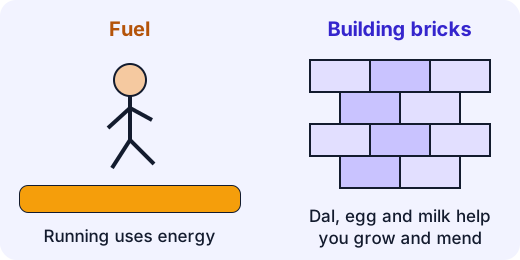
Food does two big jobs
Think of your body as a busy little town.
- Food as fuel. Every time you run, think or even sit, your body uses energy. Food is where that energy comes from.
- Food as building bricks. You are growing! Your muscles, bones, skin and hair are made and mended from the food you eat.
Some foods are better at one job than the other.
Kind of food Foods like these Main job Quick-energy foods roti, rice, poha, potato, oats, bananas Give you energy to play and learn Growth foods dal, beans, chickpeas, eggs, fish, paneer, milk, curd, peanuts Help your body grow and mend Keep-me-well foods carrots, spinach, tomatoes, guava, apples and other fruits and vegetables Help your body stay healthy and your tummy work well Treats jalebi, chips, sweets, fizzy drinks Taste nice, but give a lot of sugar or oil and little else Most foods do more than one thing. A glass of milk helps you grow and it also gives some energy. We say "main job" because each group is best at one job.
Try it: Look at your last meal. Which foods were fuel? Which were bricks? Was anything from the keep-me-well group?
Why a sweet is not the best fuel
A sweet gives a quick burst of energy. But it can run out fast, and then you may feel tired again. Roti, rice and oats are quick-energy foods too, but they release their energy more steadily, so you keep going longer. That is why a good meal has a quick-energy food and a growth food together.
Plan a day of meals
A meal plan says what you will eat at each time of the day. Most people have breakfast, lunch, an evening snack and dinner.
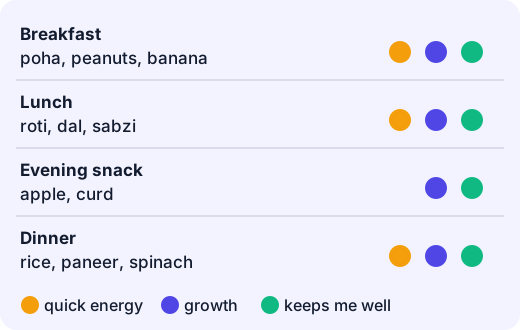
Example. Here is how to check a plan.
- Breakfast: poha (quick energy), peanuts (growth), banana (quick energy and a fruit). It has fuel and bricks. Good.
- Lunch: roti (quick energy), dal (growth), sabzi (keep-me-well). All three groups. Good.
- Snack: apple and curd. A fruit and a growth food. Good.
- Dinner: rice, paneer, spinach. Fuel, bricks and a vegetable. Good.
Use foods your own family likes and cooks. A plate in Kerala, Punjab, Nigeria or Peru will look different, and they can all do the same jobs.
Mix-ups to watch for
- "Growth foods only help little children grow." Your body keeps mending itself all through life.
- "Treats are forbidden." A small treat now and then is fine. They just should not take the place of meals.
- "Skipping a meal is no big deal." When you skip a meal, your fuel runs low, just like Kabir's.
For the grown-up helping
Talk about what food does ("this will give you energy for the swings") instead of rules. Let your child pick and help prepare a food from each group. Treat names such as "growth food" as handy labels; nearly every food has more than one job. If you have worries about your child's growth, appetite or allergies, speak to a doctor.
Lab
Plan a day of meals
First sort eight foods by their main job. Then plan breakfast, lunch, a snack and dinner, and watch the checklist tick off as your plan gets better.
Your goals
- Sort eight foods into quick energy, growth, keeps me well, or treat.
- Plan a day with fuel and a growth food at breakfast, lunch and dinner.
- Include at least three fruits or vegetables and no more than one treat.
The interactive lab opens once you register. Register to do this.
Activity
Plan tomorrow's meals
Your child plans a real day of meals for the family and sorts the foods into jobs. About 20 minutes, and then you cook or serve part of it.
You'll need
- Paper and coloured pencils (amber, blue, green)
- A list of foods your family eats
Steps
- Draw four boxes on paper and label them breakfast, lunch, snack and dinner.
- Together, name foods your family eats. Your child writes or draws each one in a meal box.
- Each food gets a coloured dot. Amber is quick energy (roti, rice, poha, potato). Blue is growth (dal, egg, milk, paneer, fish, peanuts). Green is keeps-me-well (fruits and vegetables).
- Check each main meal. Does it have an amber dot and a blue dot? Does the day have at least three greens? Change the plan until it does.
- Pick one meal from the plan and make it together, with your child washing, sorting or stirring (adult does the cutting and the cooking).
- Ask "Which food in this meal is fuel? Which is bricks?" and listen to the answer.
Safety
- An adult does all cutting, hot cooking and handling of the stove.
- Check for food allergies and any foods your child must avoid before the plan is made.
- Wash hands and fruit and vegetables before preparing food.
Keeping a log of the activity is for registered learners. Register to do this.
Quick check
Food and energy check
Six questions about fuel foods, growth foods and meal plans.
1.Which of these is mainly a growth food?
- A boiled egg
- Plain boiled rice
- A jalebi
Choose one
2.Dina has a running race in one hour. Which snack will give her quick energy?
- A banana
- A glass of plain water
- A few slices of cucumber
Choose one
3.Pick all the growth foods.
- Curd
- Plain rice
- Paneer
- A lollipop
- An egg
Choose all that apply
4.Match each food to its main job.
- Roti
- Dal
- Spinach
Match each to: Keeps you well · Growth · Quick energy
5.Look at the day's plan. How many of the four meals have at least one growth food?
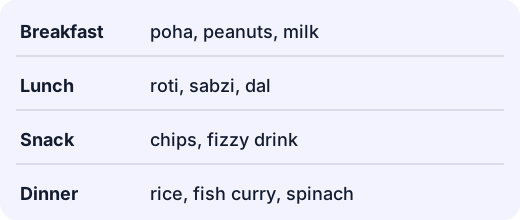
Answer with a number
6.Put the day's meals in the order we usually eat them, first to last.
- Lunch
- Evening snack
- Dinner
- Breakfast
Put these in order
Answering and checking are for registered learners. Register to do this.
Quick check
New puzzles
Use what you know about fuel and bricks in some new situations.
1.Arjun will walk up a hill all morning. Which breakfast is best?
- Only a bowl of sweets
- Roti with an egg and a banana
- A fizzy drink
Choose one
2.Mei's dinner is rice, dal, curd and spinach. How many of these are growth foods?
Answer with a number
3.Sam says, "Dal is a growth food, so it can't give any energy at all." What is the best reply?
- Sam is right. Growth foods give no energy.
- Not quite. Most foods do more than one job. Dal's main job is growth, and it gives some energy too.
- Dal is not a food that does a job.
Choose one
4.Ravi ate only jalebi for lunch. By afternoon he feels tired and hungry again. What would help most at his next meal?
- Add roti and dal, so he gets fuel that lasts and a growth food
- Eat more jalebi
- Skip dinner
Choose one
Answering and checking are for registered learners. Register to do this.
Activity
Tell it back
Your child explains, in their own words, what food does inside the body. Three minutes.
Steps
- Show your child two foods, such as a roti and a boiled egg (or a banana and some dal).
- Ask "What does each of these do for your body?" Let them answer before you say anything.
- Ask "If you had a big game this afternoon, what would you eat at lunch, and why?"
- Write down what your child says, in their words.
Keeping a log of the activity is for registered learners. Register to do this.
Like what you see?
Register for free to answer the quick checks, do the activities and save your work. Your work is saved on your device and syncs to your account.