Unit 3
Water safety
Learn the rules that keep water fun, how to help without going in, and how a back float works.
Read
Fun in the water, safely
On the first day of the school holidays, Kabir's cousins took him to the river near their village. The water looked calm and cool. Kabir was a good runner and wanted to dash in.
"Wait," said his aunt. "Look first. See those ripples in the middle? That water moves fast. We will play where it is shallow and I can see you."
Kabir splashed happily in the shallow part with his cousins. A little later a boy farther along the bank slipped into the deep, fast part, and a grown-up had to rescue him. Kabir was glad his aunt had made the rule.
Water is wonderful. We drink it, wash in it, swim in it and play in it. But water can be dangerous, even when it looks calm, because a person can slip under quickly and quietly. Rules keep water fun.
Rules near water
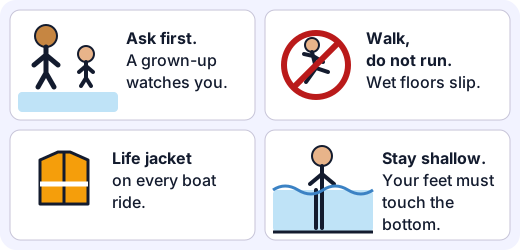
- Ask first, and have a grown-up watching. Never go into or near water, such as a pool, pond, river, sea, canal or well, without a grown-up who knows you are there and is watching.
- Walk, don't run. Wet floors and rocks are slippery.
- Wear a life jacket on a boat, and wherever a grown-up tells you to.
- Stay in the shallow part, where your feet can touch the bottom, until a trained teacher or grown-up says it is safe to go deeper.
- Never swim alone, not even if you swim well. Anyone can get tired or get a cramp, and someone needs to be there to help.
- No pushing, dunking or jumping on others. A joke can turn dangerous.
- Know the danger spots. In many places the dangers are fast rivers in the rainy season, flooded streets, canals, ponds and open wells or tanks, as well as sea waves and currents. Stay away unless a grown-up is with you.
Try it: Imagine the place nearest your home with water. What are the dangers there? Which rules would you use?
If someone is in trouble
Think "reach or throw, don't go."
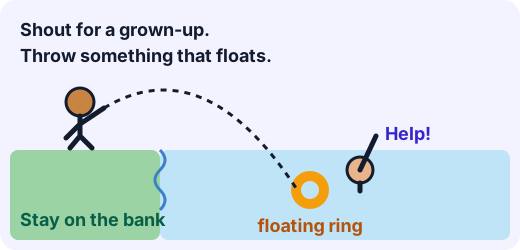
- Shout for help and find a grown-up. In India, adults can call 112, the national emergency number. Use your country's number elsewhere.
- Throw something that floats, such as a life ring, a float board or an empty plastic bottle with the lid on.
- Stay on the bank. Do not jump in after someone. A child who goes in to help can end up in trouble too.
Floating
Floating is a skill that can keep you safe, because a floating person can breathe and wait for help. Learn it in a pool or other calm, shallow water with a grown-up or swimming teacher beside you.
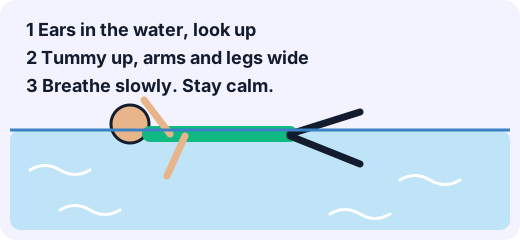
The back float:
- Hold the side of the pool, or your teacher's hands.
- Lean back and let your head rest on the water, with your ears in and your eyes looking up.
- Lift your tummy gently, and spread your arms and legs wide like a star.
- Breathe slowly and stay calm. Kick a little if your legs sink.
If you ever fall into deep water by accident, the best plan is the same: lean back, spread out, float, breathe, and call for help. Don't thrash about, because that tires you out.
A mistake people make
"I can swim, so I'm safe." Swimming well is a great help, but it does not make you safe alone. Rivers, waves, cold water and tiredness can beat even strong swimmers. The rules are for everyone, including good swimmers.
For the grown-up helping
Stay within arm's reach of children this age whenever they are in or near water, and keep your eyes on them without looking at your phone. Drowning is usually silent, with no shouting or splashing. Empty or cover buckets, tubs and tanks. Check for lifeguards and depth signs at pools and beaches. If facilities exist, enrol your child in swimming lessons with a qualified teacher; floating and moving in the water are skills best learned with a trained instructor. This unit gives general safety education and does not replace swimming instruction or first-aid training.
Lab
Spot the danger
Look carefully at the busy waterside. Click each danger you find, then pick the rule that fixes it. Watch out, some things in the picture are safe.
Your goals
- Find all six dangers in the picture.
- Choose the right safety rule for each one.
The interactive lab opens once you register. Register to do this.
Activity
Water rules walk and float practice
Your child spots water dangers around your home or neighbourhood on a safety walk, practises "reach or throw", and, if you have access to a pool with an instructor or lifeguard, tries the back float. About 30 minutes.
You'll need
- Paper and a pencil
- An empty plastic bottle with the lid screwed on, or a pool noodle
- Optional, for the float, a shallow pool with a lifeguard or swimming teacher, and swimwear
Steps
- Walk around your home, street or school with your child. Look for places with water: buckets, tubs, tanks, drains, ponds, canals, wells or a pool. Your child points them out from a safe distance.
- At each place, ask: "What could go wrong here? Which rule keeps us safe?" Your child draws or writes one danger and one rule on the paper.
- Practise "reach or throw, don't go" on dry land. Your child stands behind a line on the grass, you pretend to be in trouble a few steps beyond it, and your child shouts "Help!", then throws the bottle or noodle toward you. They must not cross the line.
- Practise asking: say "Can I play near the water? Will you watch me?" and wait for a clear yes before going.
- If you have a shallow pool with a lifeguard or instructor, and your child is happy to try, practise the back float with an adult beside them: lean back, ears in, look up, tummy up, arms and legs wide, breathe slowly. Stop at once if your child is scared.
- Finish by asking: "What is the most important rule near water?"
Safety
- An adult must be within arm's reach of the child at all times whenever they are in or near water. Keep eyes on them and keep phones away.
- The throwing practice is on dry land only. Never practise near open water, and never ask a child to go close to a pond, river or well.
- Float practice only in a shallow pool with a lifeguard or qualified instructor, and with an adult in the water. Never push a child to try.
- Empty buckets and tubs after use, cover wells and tanks, and keep gates to water closed.
Keeping a log of the activity is for registered learners. Register to do this.
Quick check
Water safety check
Six questions about staying safe near water.
1.Where is the safest place for a child to splash and play?
- In a shallow place, with a grown-up watching
- In a river with a fast current, if the day is hot
- In a pond when nobody is around
Choose one
2.Which of these are good rules near water?
- Walk, don't run, on wet floors
- Ask a grown-up first
- Go in alone if you swim well
- Wear a life jacket on a boat
Choose all that apply
3.Look at the picture. Your friend is in the pond and you are on the bank. What is the best first thing to do?
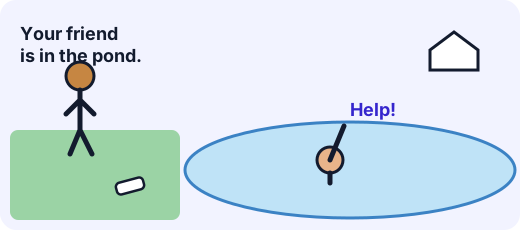
- Jump in and pull your friend out
- Shout for a grown-up and throw something that floats, staying on the bank
- Wait and see what happens
Choose one
4.Put the steps of the back float in the right order.
- Lean back with your ears in the water, looking up
- Breathe slowly and stay calm
- Lift your tummy and spread your arms and legs like a star
- Hold the side or a teacher's hands
Put these in order
5.Dev is a strong swimmer. Why should he still not swim alone?
- He could get tired or cramp, and nobody would be there to help
- Swimming alone is boring
- Strong swimmers always get lost
Choose one
6.Match each place to its danger.
- A wet pool edge
- A river in the rainy season
- An open well
Match each to: The water is fast and strong · You could fall in and not be able to climb out · It is slippery, so you can fall
Answering and checking are for registered learners. Register to do this.
Quick check
New puzzles
Water dangers turn up in places you might not expect. Can you use the rules?
1.After heavy rain, your kite lands in a flooded street. The water looks shallow. What should you do?
- Leave the kite and tell a grown-up
- Wade in quickly before someone else takes it
- Dare a friend to get it
Choose one
2.A friend says, "There's no lifeguard at the lake. Let's swim anyway. Nobody will know." What is the best reply?
- No. We need a grown-up with us. Let's go and ask
- OK, but only for a minute
- Okay, I'll race you in
Choose one
3.At a family party you see your 4-year-old cousin walking toward a hotel pool with no lifeguard. The grown-ups are busy talking. What should you do?
- Tell a grown-up straight away, and call your cousin back to you
- Carry on with your game; someone will notice
- Walk behind the cousin to the pool and see what happens
Choose one
4.From the bank, which could you throw to someone in trouble in the water?
- An empty plastic bottle with the lid on
- A pool noodle or a float board
- A heavy school bag
- A brick
Choose all that apply
Answering and checking are for registered learners. Register to do this.
Activity
Tell it back
Your child explains, in their own words, why water is fun but needs rules. Three minutes.
Steps
- Ask "Water is lots of fun. So why do we need rules near it?" Let your child answer fully.
- Ask "Tell me three rules for staying safe near water."
- Ask "What would you do if a friend fell into a pond and you were on the bank?" Do not give the answer; ask "What else could you do?"
- Write down what your child says, in their words.
Keeping a log of the activity is for registered learners. Register to do this.
Like what you see?
Register for free to answer the quick checks, do the activities and save your work. Your work is saved on your device and syncs to your account.